



Author’s Note:
Hey cousins! Welcome to Southern-izms, a space serving as a digital love letter to Southern Black Culture and Voices. Thank you for tapping in with us for our sixth edition! If you are a returning to the series: hey boo! Welcome back😘 We love familiar faces over here! I hope everyone is doing their best to take care of themselves 💖
This edition is super special to me because it is a collaboration with one of the first Black Southern Gothic writers I encountered on my timeline: E.A. Noble! I first saw her work with the announcement of her series MISSISSIPPI GOTHIC, and have been tapped in ever since. Not only has her series been one of my favorites on this app, but her work has inspired me to tap into writing my own Southern Gothic series! She has shown me that if you have a vision for it, bring it to life because you never know where you work can carry you. I thought it was only right to have her be a part of this series highlighting Black Southern Storytelling! Please do not forget to scroll below to see her author’s bio and a couple of links to support her work.
Introduction:
You cannot speak of Southern Black culture and not honor our gift of storytelling! A tradition so deeply steeped into the fabric of who we are, storytelling has remained a key component of culture as it helps us to stay connected to both the past and present. Whether it be our cultural folklore, or personal stories, each carry our voices far beyond our own lives, carried by the generations. Our stories serve as altars, bridging connections to people, places, and even spirits whose truths (no matter how gruesome) can serve as a guiding light to our current lives. The curation of the story is specific as the individual telling the story: what truths do they wish to share? How intricately do they want to weave it into the story? Do they leave the truth bare, easy for you to devour, or will they withhold it for you, only give you the tools to get to the truth for you to dig out yourself? If they are telling a folktale: how will the story be impacted by the region their from? Will characters go by a slightly altered name? Will the length of the story shorten due to details omitted? Even more fascinating is the style in which the story will be told. Usually it depends on the story’s context and lesson to be learned; sometimes it is told in animated, fantastical way, other times in a sure, steady tone, and in dire cases: somber and melancholic. Regardless of the style, each story serves as a guide of survival while celebrating our wit, humor, triumph, resilience, and our spirits. The best part: once you have sat at the feet of an elder long enough to hear these stories, your ears become trained to the art of decoding to understand what may be nestled between the lines (aka the obvious).
If you are looking for the truth: look amongst the stories. That is where it will bear itself to you.
“Telling Stories: The Power of Black Southern Folklore” - E.A. Noble
My grandma never told me not to lie, she just told me never to say lie. “Say telling stories,” she’d say. When I asked her why, she’d look at me and say, “’Cause lie is a curse word.” Well, here I am at my big age of thirty-something, still telling stories to all who’ll listen. Because what is fiction without tall tales?
I didn’t start writing because I wasn’t introduced to Black stories. I started because I was. They fascinated me. Tall tales like John Henry, the steel-driving man who worked himself to death proving he was stronger than the machine. That story was a children’s folktale that spoke of Black labor, Black strength, and how our humanity was always measured against cold steel and industry. Then there were tricksters like Brer Rabbit, teaching us that survival often came through wit and wordplay.
For hours, my grandma and I would sit on her white porch, in front of her white house with two tall trees, wind chimes, and a little garden. We’d sip lemonade in the hot Mississippi sun while she told me stories — first for children, then for grown folks.
One day, she pointed at a house up on the hill and said, “Ain’t nobody gon’ buy that house. It’s haunted.”
“What you mean?” I asked.
She said, “You didn’t know? Miss Mary and her son lived there. They said a demon hopped on Miss Mary’s back, rode her every night till sunrise. Sho’ll did. Had Miss Mary down so low she could barely get out the bed. One day, Miss Mary said she gon’ end the devil once and for all. Got in the tub and slept underwater. Never got back up. Son found her like that. Said he still see her at night. Then one day…”
Grandma leaned in close. We both looked at the empty, charred window of that burnt-down house. Paint peeling, yard overgrown, roof caved in.
She whispered, “Devil got angry. Said he’d find a new back to ride. Jumped on the son. Rode him long, rode him hard, till he turned mad. Po’ boy said he had to finish what his mama started. Miss Mary tried the flood, and now her son gon’ bring the fire. Mmm-hmm. And that was the last of Miss Mary and her boy. Never seen again.”
And I believed every word. For the longest time, I thought that house was truly haunted. I stayed up nights watching those windows, waiting for Miss Mary, her son, or the devil to appear. But when I got grown, I learned the devil was depression. The flood and fire were metaphors. And the son disappearing? That was code for he was committed.
And honestly, I still don’t know which version of that story hurt worse.
In Black Southern towns, there’s a story like that on every street corner, every beauty shop, every candy lady’s porch. From the projects to the pews, the college yard to the cotton fields. Stories live everywhere. As a child, especially an undiagnosed autistic one, I could never tell if folks were speaking truth or just “telling stories.” Now I realize, it was both. Truth wrapped in fiction. Pain covered in negro spirituals. Rebellion carried on through the crackles of bonfires. Hope clothed in big church hats and ring shouts.
One tale that always stuck with me is The Freeman. This story goes by many names. A man was granted freedom by his master, but before his wife and child could be freed too, the master died and left everything to his cruel son. And out of the cruel son’s jealousy, he planned to separate the freeman from his family by selling the wife and child away. But before he could, the freeman gathered his family one early morning and fled. The cruel son chased them through woods and hills until, cornered on a cliff, the freeman and his family leapt. When the master’s son looked down, he saw no bodies…just three birds flying free.
Maybe the family had turned into birds, grew wings, and escaped. Maybe there was another reason why no bodies were found. Maybe the waters below swept them away.
Later, I found out there might be some truth buried in that tale, and how it could be tied to the Underground Railroad itself. See, the Railroad also used mountains and rough terrain as cover to move unseen. When the freeman and his family jumped, they could’ve landed on a hidden ledge, right out of view, and slipped into the open mouth of a mountain tunnel. When the master’s son came looking, he saw nothing but a family of birds taking flight.
So the story spread, passed from mouth to mouth, a coded message hidden in a bedtime tale. To some, it was just a story of freedom. But to others, it was a map.
Every tale had two lives: the one told out loud, and the one living underneath. Back in the day, stories were also survival tools. Folklore, songs, and even quilts carried hidden codes and messages for freedom seekers.
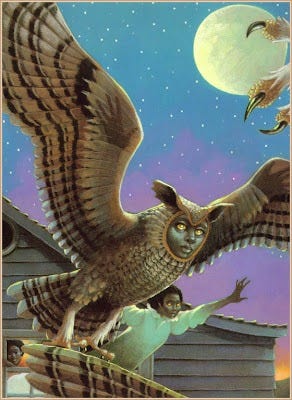
The spiritual “Follow the Drinking Gourd” was about hope, but it also pointed to the Big Dipper, guiding enslaved people north. Quilts hung on porches marked safe houses and escape routes. Certain patterns, like “Log Cabin” or “Wagon Wheel”, had meaning known only to those in the know.
And just like those songs and stitches, stories like The Freeman worked the same way. You couldn’t just come out and say, “There’s a tunnel in the mountain.” So you said, “A family turned into birds and flew.” That way, the story lived free and safe on people’s tongues, never dying, never forgotten.
Black folklore is horror and humor, and every damn thing down to the maple tree. It’s comedy, tragedy, triumph, and transformation. It’s the blues singer who sold his soul for fame and the little girl who tricked the devil by handing him the soles of her shoes instead of her soul. It’s outsmarting oppression, one story at a time.
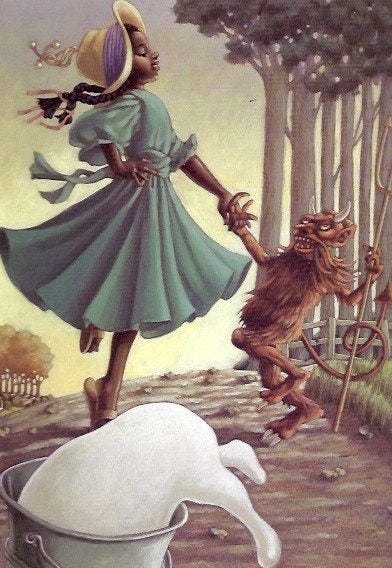
Every generation’s got its own way of sending messages in plain sight. Back then, they hid escape routes in hymns and bedtime stories. Today, we don’t have to hide safety in prose. Every story we tell, every page we write, we shout! We don’t have to hold back if we don’t want to. Write, don’t stop writing, write some more. Tell stories!
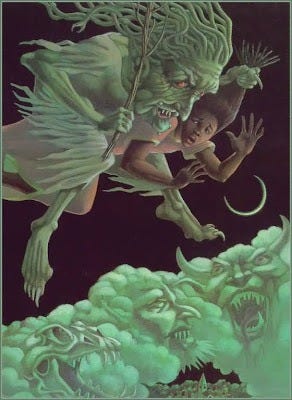
As a writer, these tales keep my pen alive. My biggest fear? That they’re dying. Everywhere I look, I see European folklore — vampires, werewolves, Thor, Loki — and I love those stories too. But where are ours? Where are the stories of us?
I once asked my grandma about the old hidden languages and songs folks used down South. She said, “Yeah, we had them. Songs we’d sing to warn each other when trouble was coming. Stories we’d tell to keep each other safe.”
When I asked her to tell me some, she said, “Oh baby, that was long ago. I can’t ’member now.”
“Why didn’t you tell me back then?” I asked.
She said, “I didn’t think they were needed no mo’.”
And that broke me.
Because every day, these stories are dying with the people who lived them.
Who gon’ tell Grandma’s stories when she gone? Who gon’ tell ours when we gone?
It’s on us — Black folks, Southern Black folks, honey-tongued, slow-drawl, porch-sitting, road-running, diaspora-spread kinfolk—to keep telling our stories.
We done seen a thousand remakes of Cinderella. But what about Catskinella, the Black Southern girl who ran from a bad marriage, wrapped in cat fur, and turned her skin-tight catskin to royalty?
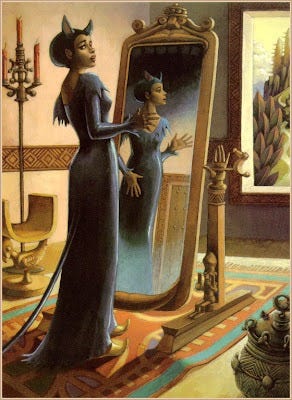
I’m making it my soul’s duty to take our stories, dust ’em off, and breathe life back into them—because when we tell our stories, we don’t just remember. We resurrect. Revive. Breathe. Live. Storytelling is our code, our key, our Underground Railroad. It’s how we smuggle truth through time, past those who tried to silence us. Every time I write, I’m retelling and reshaping what was left behind, carrying messages across generations to the ones coming after me saying proudly, “We were here, we are here, we gon’ be here.”
A lot of people will try to convince us that our stories are “lies,” “cursed” words that should be buried. But telling stories is one of the things that makes our culture our culture and our voice our voice. So, let me be clear, don’t go around saying, Noble said it was okay for you to lie! (lol)
What I’m saying is this: you have ancestral rights to tell our stories. Nonfiction, fiction, supernatural, romance, folklore, whatever speaks to your spirit.
So, light the porch, pour some lemonade, and tell stories like Grandma would.
Happy storytelling, my friends.
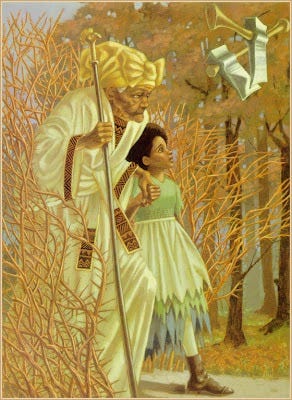
Recommended Reads: Keep the Stories Alive
If you want to learn more about the depth, wit, and wild imagination of Black American folklore, start here:
The People Could Fly: American Black Folktales by Virginia Hamilton
A cornerstone collection of African American folktales—magical, moral, and deeply human.African American Folktales: Stories from Black Traditions in the New World edited by Henry Louis Gates Jr. and Maria Tatar
A massive anthology collecting centuries of oral storytelling traditions from across the diaspora.The Annotated African American Folktales edited by Henry Louis Gates Jr. and Maria Tatar
Context and commentary meet classic tales—from tricksters to freedom seekers.
Her Stories: African American Folktales, Fairy Tales, and True Tales told by Virginia Hamilton. Illustrated by Leo & Diane Dillon
Beautiful tales of Black folklore.
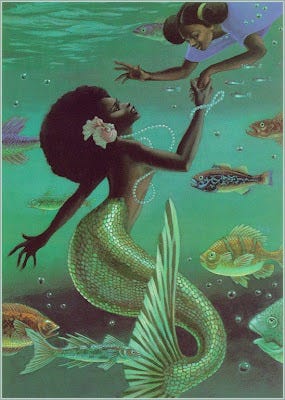
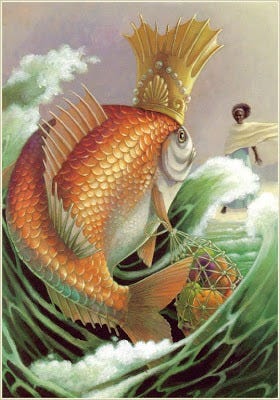
Leo & Diane Dillon art called Mary Belle and the Mermaid -
from Virginia Hamilton: Her Stories
❤️Closing Notes❤️
To the reader: Thank you for being here💕This series has been steadily growing and it’s all thanks to you! Southern storytelling is an art I have been wanting to dive into, so you can expect more pieces highlighting our folklore. Please share below some of your favorite folktales and stories you’ve heard!
To E.A. Noble : Thank you for sharing your gift with the series. To have a dedicated writer such as yourself express excitement to be part of a building series means the world to me. You are phenomenal in many ways, and I can’t wait to witness how you continue to grow in your gift, and read all of the wonderful work you produce! 💟
As always,
Be safe. Be diligent. And I love y’all down!
- Kéi, Your Southern Dove 💋
E.A. Noble Author Bio
E.A. Noble studied Creative Writing as an undergraduate at Jackson State University, an HBCU in Jackson, Mississippi. Her debut novel, When Blood Meets Earth, won a 2025 Indie Literary Award for Best in Urban Fantasy. Her previously published works can be found in FIYAH Lit Mag, and more to come. For more information, please visit theeajournal.me!
Please check out her series MISSISSIPPI GOTHIC below! I have included the Introduction, Chapter One and her most recent update for Chapter Twelve 😊

If you are interested in being featured in the series Southern-izms, please feel free to repost this with a note, reply, or DM me to start brainstorming. All ages, identities, and Southern regions are welcome!
If you are a Southern Black creative that would like to be featured in Southern-izms, and have a virtual gallery designed, DM me and we can bring your work to life! Please note that links to purchase your artwork can be included. I am not currently producing this series for any financial profit, so any proceeds collected through direct links (including commission links) are 100% yours. <3
If you are a Black creative and are interested in collaborating in a virtual gallery (outside of the Southern-izms series), let me know. I would love to work together!
Southern-izms: The Intro: #00

Ism - manner of action or behavior characteristic of a (specified) person or thing” - Merriam Webster


Beautiful! I also love Southern Gothic stories. This is an amazing art form and style for telling and teaching about the human condition.
This was a very nice read to wake up and read. I also follow ea and obsessed with her Gothic southern series.